Psycho. #66
Tarantino, Dano, yes and no.
Tarantino vs Dano. I’d be happy enough if not just Tarantino’s opinions but his entire output was sent towards a black hole; we’d still have the original films – I’m talking of the diverse cinema from which he synthesised an average, like some kind of proto-AI. But Dano is sui generis. Why should we treat Tarantino’s assessment of Dano as anything other than a laughable glitch?
I almost wish that you had written only the first three words of this ‘question’, but sadly etiquette won out and you submitted to asking an actual question, with its requisite punctuation mark. When I was in secondary school in France, an urban legend went around which said that, in French higher education, at the grandes écoles, students taking philosophy classes would be asked for 5000-word essays on, simply, a subject, rather than a question. For one such paper, we heard, the subject was simply ‘meat’. Of course, these days, as a vegetarian, I reckon I could probably smash out a sweet 5000 words on ‘meat’. But of course, a philosophy paper would need to cite Hegel and, I don’t know, Foucault, and speak of the concept of ‘meat’, its relationship to our humanity, perhaps to the idea of flesh and the religious, etc etc.
“Tarantino vs Dano” is a baller of a question, and I suppose in the way you have laid it out, it does have an element of the philosophical about it, because at heart you are asking me to consider their essences, which are discrete and even oppositional. On the one hand, Tarantino, the great synthesizer or recycler; and on the other hand Dano, a true original, as you have it. I don’t know if I wholly agree with the premise, but I do appreciate it very much.
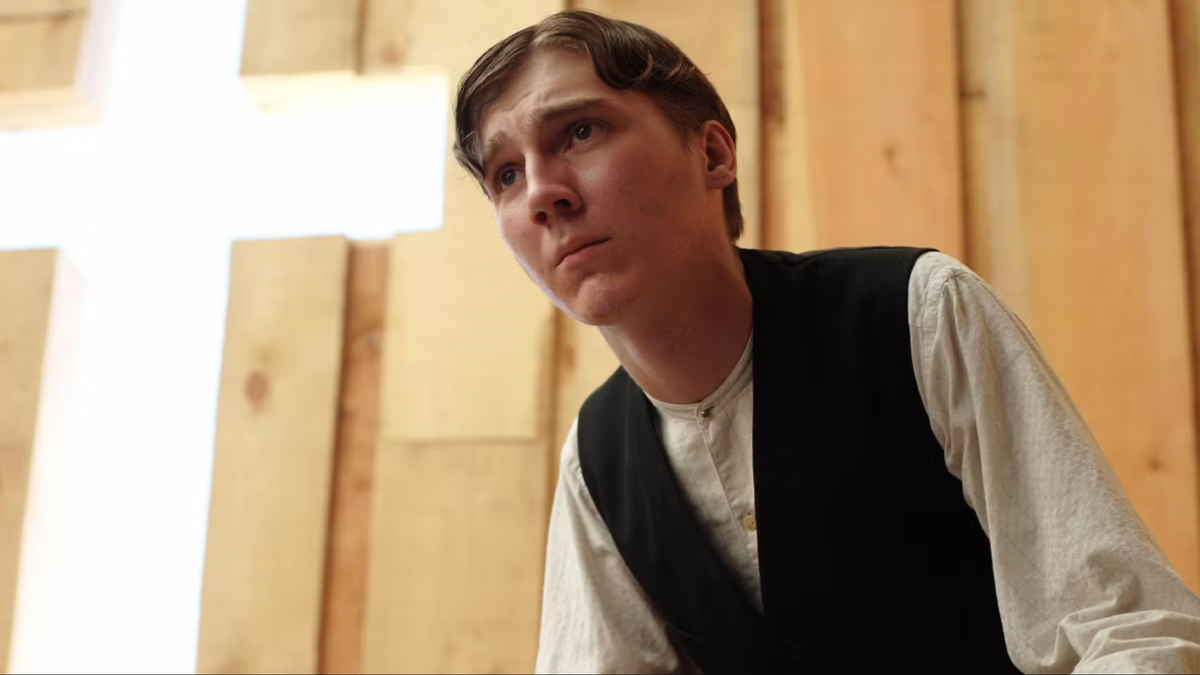
But first let’s return to the kerfuffle. In an uncharacteristically unguarded moment late last year, the ever charming Quentin Tarantino took it upon himself to rubbish Paul Dano for his performance opposite Daniel Day-Lewis in There Will Be Blood. He said that the film would stand a good chance of being the top film of this century if “it didn’t have a big, giant flaw in it… and the flaw is Paul Dano.” He then added: “Obviously, it’s supposed to be a two-hander, but it’s also drastically obvious that it’s not a two-hander. [Dano] is weak sauce, man. He is the weak sister. Austin Butler would have been wonderful in that role. He’s just such a weak, weak, uninteresting guy. The weakest fucking actor in SAG.”
Well. The first thing that catches my attention here is what I consider to be a gross misrepresentation or misunderstanding of There Will Be Blood, which is not supposed to be a two-hander.
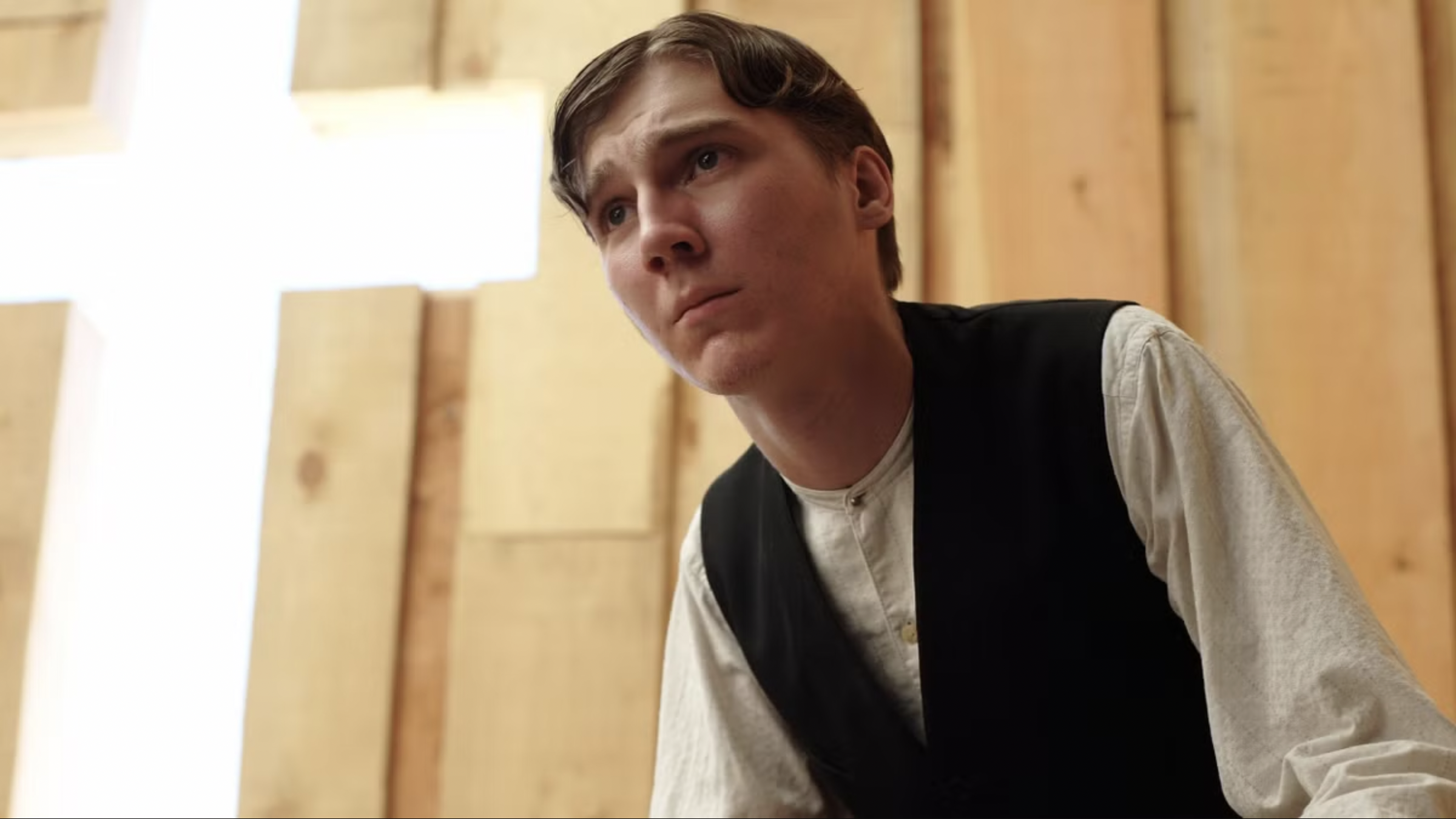
The film belongs to Daniel Day-Lewis and his character Daniel Plainview, and everybody else is a secondary character, including the child played so brilliantly by Dillon Freasier. Day-Lewis bestrides the film, monsters it even; pushes everybody else out, and this works wonders because it is also the way of his megalomaniacal character. Paul Dano is certainly a weaker actor than Daniel Day-Lewis, but he doesn’t need to be on Day-Lewis’s level, and in fact it is better for the film that he not be. When his character, Eli, tries to stand up to Daniel Plainview, you can sense the exhilarating fear coursing through him at his own audacity, and likewise Dano does not command the screen fully in his big scene in the church. We sense a younger actor trying, and summoning his utmost – and that level is right. There Will Be Blood is not a two-hander: it is emphatically a one-hander in which a secondary character steps up and fails. That is how it must be.
I should note that Freasier does something similar, although his character, H. W., is used differently. We see somebody being used for their apparent complicity and understanding, but that was never there. Eli was never able to stand up to Daniel, H. W. unable to get close to him. In both cases, we see that they were mistaken. Both of them fall away to leave only Daniel Plainview and his monstrous ego remaining. As I keep saying: this is right. Paul Thomas Anderson doesn’t make that sort of big mistake.
Now, as to the forces governing Tarantino and Dano, and what makes them who they are… gosh. I don’t know, man. I can’t really find fault with your interpretation – because of course Tarantino is a filcher, and god knows I dislike him and his career; and of course, since you say so, I find myself unable to find strong parallels for Paul Dano throughout film history, lending credence to your view that he is sui generis. But I think there may be a little overstatement in your stance, too. Tarantino has certainly ripped off De Palma, blaxploitation and samurai and spaghetti western films – he told the Los Angeles Times in 1994 about his urge to “steal from every movie I see” – but I do think that within that synthesis he has been able, for better or worse, to find something approaching a personal style, or imprimatur. Looking back at your question again, I see that you don’t say much to the contrary; but I guess he should be given a modicum of credit, at least, for a relatively successful synthesis. It’s too cruel and not quite right to see in him merely a “proto-AI”.
Wow, I can’t believe I have written two or three sentences in (muted) defence of Tarantino, whom I loathe. Start readying my Nobel peace prize!
Likewise, Dano is probably an original, but I don’t think I can fully go along with an account of him that perceives him as much more than a capable character actor with a good face and intangible screen presence. Dano at his best can be very good; I actually rather like him in understated mode, for instance in Little Miss Sunshine, where he is very touching as, simply, “a teenager”. In Kelly Reichardt’s brilliant, unjustly neglected Meek’s Cutoff he is good and somewhat unremarkable – but the main thing is his demeanour and his presence, which count for a lot. Likewise 12 Years A Slave, which requires a face just like his. He fits in remarkably well here and his character – a pathetic, lowly slave-owner – is immediately obvious to us. Interestingly, Brad Pitt, an actor favoured by Tarantino, appears in a number of scenes in 12 Years A Slave and acquits himself poorly. He does not fit in. He looks wrong. His character is badly circumscribed.
I quite like Paul Dano in Prisoners! But again, he is a character actor here, and what works in the movie is that he is secondary to movie stars, namely Hugh Jackman and Jake Gyllenhaal. He is able to act opposite that type of actor, that’s his sweet spot; a smear of grease, a little daub of something strange, in an otherwise gleaming picture. There have been character actors before him though – for instance, Kevin Spacey, Judy Greer, Parker Posey, or even somebody further afield such as Steve Buscemi or Brad Dourif. As Paul Dano has aged, he has started to make more sense in this type of lineage. He was always a less comfortable proposition as a young premier.
I also can’t let this question go without mentioning Dano’s sometime overacting, which reaches a peak in The Batman. Apparently haunted by the ghost of Heath Ledger, Dano goes big here, with decidedly mixed results. I’m OK with that – I would rather see someone take a big swing rather than hold back – but I think the mistake is to do with Dano’s screen persona, which shouldn’t require him to try and counter star power, but rather serve it or toy with it from the sidelines, add decoration to it and throw it into relief.
Tl;dr: Tarantino is full of shit as usual, but I am surprised that he made such an error of interpretation, as he can sometimes be an astute cinephile; and Dano is a fine presence, if used correctly. I genuinely don’t think Tarantino can understand such a presence, because it comes without fireworks, and subverts the type of machismo that Tarantino trades in. Increasingly his actors are given to showboating and to empty illustrations of ‘star-power’: it’s certainly not a loss to Dano that he won’t soon enter such a world.
Send your questions anonymously to Caspar at this link, no personal information is collected.