On Emerald Fennell's Wuthering Heights (2026)
Should a film necessarily be faithful to the book or prior work that it’s adapting? The big of brain and hot of take were out in force, around the time of the release of “Wuthering Heights” , to argue for either side of the motion, thereby leading our culture to be greatly enriched. Heartfelt thanks to anybody who dusted off their front-facing camera in those heady days, and started a video with the hallowed words, “OK so let me tell you why…”
Of course, total adherence to the work in question is a dead-end. Some years ago, I went to see Spike Jonze’s Where The Wild Things Are with friends. Afterwards, someone was quibbling about some element that hadn’t made it from book to screen, whereupon another friend – a little impatiently perhaps – snapped, “Well, yeah, and there also wasn’t a finger turning the pages.” It goes without saying that a filmmaker must take some liberties with a text in bringing it to the screen. This is not just a self-evidently necessary process in making prose fit to a different medium and tailoring a story so that it can be apprehended visually, but an intrinsic part of the creative process, whereby artists put their own imprint on something. For a few good examples of this, you only have to listen to the original version of anything covered by Aretha Franklin and then her own version, in which she usually changes the very musical fabric of the song and sometimes even its meaning. The most famous example of this is obviously her imperious cover of Otis Redding’s “Respect”, which in its original iteration is essentially a low-down appeal from a man for, god damn it, a bit of sex when he gets home after a hard day at work; Aretha vamps it up and turns the song into a righteous demand for actual respect. In a similar vein I recommend her much less well-known take on “My Way”, a brilliant performance in which she strips most of Sinatra’s rancid vainglory from the song, and turns it into something generous, encouraging, celebratory.
Are these adaptations – for that is what they are – faithful to the spirit of the original, and does that matter? Well, whatever tweaks Franklin makes to the o.g., in each cover you can hear that she’s adopted the same melody at least; the tune stays broadly the same, and there are even touches that seem to enter into a really fruitful, crunchy kind of dialogue with the former versions, teasing out their qualities or foibles in illuminating ways. Emerald Fennell’s “Wuthering Heights” doesn’t sing the same tune as the book by Emily Brontë; it doesn’t contain the chorus, and there are whole parts where the film just goes “la la la la la”. Fennell has as good as admitted this, stating that the quotation marks around the title are an indication that this is her own personal spin on the novel, and not an authoritative transposition. Well, quite. Quoth Fennell: “I wanted to make something that was the book that I experienced when I was 14” – adding that her own amendments to the text are things she had remembered from the novel as a teenager, in her own fantasies of that world, but which turned out not to have been in it. I don’t wish to be unkind, but is there anyone whose perspective on the world at the age of 14 is worth engaging with? Remembering my own thoughts and utterances at 14 makes me want to bite my own arm off, and that is as things should be.
Again: does the film have a duty of fidelity to the book? I grow impatient here. Sorry, but if you’re not going to adapt the book, then why adapt the book? I’m reminded of the time a few years ago when I bumped into somebody I knew after a screening of the Darren Aronofsky film Mother! (2017). I was, naturally, seething about what had been done to me, and to cinema, over the last two hours, and when this person asked me my opinion of the film I must not have held back. But, I said, what did you think? Well, they said – I’m paraphrasing here – it wasn’t good, per se, but then, does a film have to be good? They quite liked that it was bad, and had found that interesting. Let me stop you right there, pal. Yes, a film should be good. Next!
Fennell knows very well that a film need not religiously cleave to the text, and the proof of that is her previous film, Saltburn (2023), a knowingly trashy riff on Brideshead Revisited. The film doesn’t pretend to be an adaptation of Waugh’s novel, but loosely uses its structure to fool around and create a juicy comedy of manners (For my sins, I had a good time watching Saltburn: I acknowledge it is a deeply flawed work, which severely runs out of ideas and tests the audience’s goodwill, but it has Barry Keoghan, a great actor and disturbing presence, in the lead role, and its rompy silliness perfectly suits Fennell’s tendency towards smart-aleckry).
So why Wuthering Heights? Why this version of it? And why is that version so appalling? Part of the answer, as already mentioned, is that the film doesn’t even speak the same language as the book. Emma Thompson’s celebrated adaptation of Sense and Sensibility (1995) is a famous – and now perhaps rather tediously obvious – lesson in how to respect the essence of a novel, while departing in a few particulars; but for another example you could also look to Jan Švankmajer’s Alice (1988), a take on Alice’s Adventures in Wonderland. That film’s vernacular is of a piece with Lewis Carroll (while still remaining deeply Švankmajer) because of its perversity, and its simplicity of terms. The spirit of Carroll obtains here, perhaps a little shorn of some of its wit in favour of drawing out its sheer weirdness. That is especially notable in its combination of stop-motion and live action, a felicitous finding that brings the shock and alienation of Carroll to the fore. But Fennell works in a notably different idiom to her precursor: to Brontë’s wild and untameable, brown-haired, young and Yorkshire-born and raised Catherine, she replies with the frighteningly composed, blonde, no-longer-young, Australia-born and raised Margot Robbie. You might as well cast Colin Firth as the Godfather, or John Malkovich as Roald Dahl’s Matilda. I’ll return to this particular bit of casting, because my view is that it gives the key to the whole film. But Fennell’s woefully inept means are visible everywhere – for instance, in the surprisingly unsexy sex that the film returns to again and again. Sure, sex is there in Brontë’s book, which tells of a deep, spiritual, heady connection between Cathy and Heathcliff; but that sexual rapport isn’t so endlessly winking. Fennell has no better idea than to get poor Jacob Elordi (rivetingly miscast as Heathcliff) to take his top off and do some wood-chopping. That kind of Mills & Boon or Desperate Housewives eroticism has its place, but there’s been a little too much of it for my liking lately (c.f. Josh O’Connor eating a banana in Challengers (2024)) and here it only comes off as puerile and try-hard. Of course Heathcliff, in the novel, is perceived erotically: he’s a rough and ready outcast, for god’s sake, vengeful, handsome, rugged and wild. He’s Byronic! So why not try to convey that? Elordi is certainly a very handsome man, and a game performer; but these things have rather little to do with sexual magnetism, the power of the illicit, the brooding attraction of that which cannot be tamed. Why not take eroticism seriously, and offer us somebody projecting sex without constantly announcing it?Oh right, yeah, because we’re getting a fourteen year old’s version of sex. I’m so sorry, I keep forgetting.
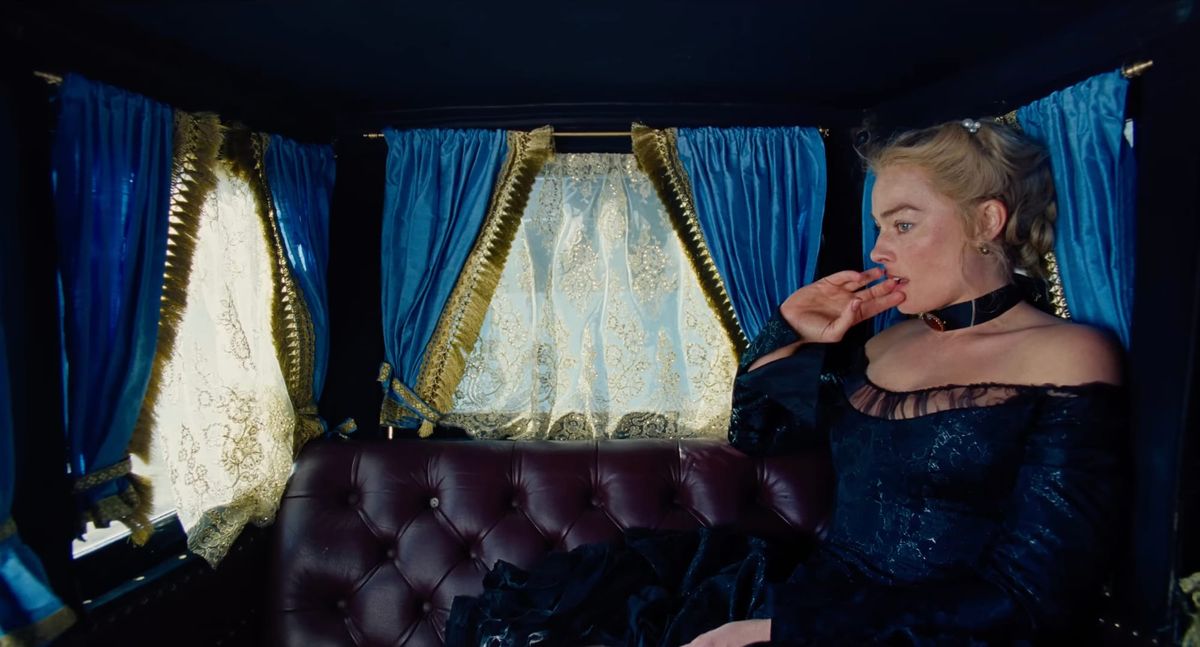
I now can’t remember who said this, and because Google doesn’t work anymore I will have to get it down from memory, but I recall that a wag observed of Titanic (1997) that for all the film’s staging of doomed forever-love, it still depicts two teenagers fucking in a car. Fennell gives us that too: her protagonists find time for a bit of nookie in a horse-drawn carriage. This is yet more teenagerdom, grafted onto a novel that considers the clash of manners and spirit, madness, revenge, and passion. This different sort of language is not up to the task of revealing the original Wuthering Heights to us, and it is not interesting in and of itself; it simply exists and presents itself to us, asking us over and over if we’re turned on; seeking our laughter; making a commotion instead of moving us. This goes for the sets and costumes, all hyper-stylised to within an inch of their life, to signify once more that this is not real, not in pursuit of dreary ‘authenticity’, but instead merely a ‘take’ on the subject. To this end, Fennell commissioned soundstages to stand in for Wuthering Heights and Thrushcross Grange, the two main houses where the action is set. These are very evidently purpose-built sets, and in their own way they are handsome, but in this critic’s opinion they significantly detract from a story that trades in grimy authenticity and Yorkshire grit. To put it another way: when your Wuthering Heights (the house) is neither high nor wuthering, you have a bit of a problem on your hands. The clothes, too, are striking enough in a kind of tacky, maximalist way, but they very much hamper the characterisation, particularly of Cathy, by again hammering home the fakeness of it all. Here is where my unifying theory kicks in, and we return to the mystifying casting of Margaret Robert.
Some readers may recollect that, a few years ago, Robbie appeared in the lead role of Barbie in the film Barbie (2023), a bold feminist treatise by Greta Gerwig that just so happened to make bank at the box office. What a triumph for this little film that could! Robbie was perfect casting for the role of Barbie – a doll with long straight blonde hair – and acquitted herself well in the part. Fennell not only saw Barbie along with every other radical feminist alive in 2023: she appeared in it, as the perpetually pregnant doll 'Midge'. What I imagine she would have seen in Gerwig's film is this: conventionally beautiful Margot Robbie moving between extravagantly artificial sets – such as the Dreamhouse, a fantastical vision in fuchsia – while wearing a number of impractical, highly designed costumes. Ring any bells?
Gerwig’s Dreamhouse contains a heart-shaped bed in pink; Fennell’s Thrushcross Grange, a room decorated in the blushing pink of Margot Robbie’s own cheeks.
As if to underline this parallel, Fennell’s film features a scene in which Catherine is presented, by Isabella, with a doll version of herself, which is then displayed within an outsize doll’s-house replica of Thrushcross Grange. What’s the Garth Marenghi quote again? “I know writers who use subtext, and they’re all cowards.” Even if you’re a bit on the dim side, you may conclude that Cathy herself, in the way she is treated at Thrushcross Grange, is like a doll. Fennell underlines this once more, just in case: in a scene after Catherine has married Edgar, she is presented with a display of gowns in her bedroom, evoking nothing so much as the dress-up costumes of a Barbie doll, improbably laid out on mannequins, to suit particular activities or moods. But Catherine isn’t really Edgar or Isabella’s doll; they supposedly have the clothes budget to trick her out like this, but in actual fact the Lintons would not have been so bottomlessly loaded as the film depicts them. And besides, Catherine has been wearing outlandish costumes from the very start. The dress money comes from Fennell’s budget. The person playing at dolls here is Fennell.
This is the key to the film – and, if I may say so, for all of Wuthering Heights’ faults it manages to correct a failing in Gerwig’s doll movie. Gerwig’s Barbie is clever and resourceful in all the uses it finds for Barbie dolls, and makes some deft jokes out of key elements of doll-playing. The biggest coup, among these, is the inclusion of a Weird Barbie, played by Kate McKinnon, whose hair has been cut and who has been drawn all over, as happens to a great many no-longer-beloved Barbies. Great. Fine. But Emerald Fennell knows that the one thing kids get their Barbies to do is fuck, and so it is that Yorkshire Barbie must have her 19th Century Ken, and they are made to smooch and grind in various locations, wearing different outfits. Is it sexy? Not really, in the same way that making a doll eat plastic sushi probably won’t get your appetite up – but it does at least explain what the hell is going on.
For Wuthering Heights is a Barbie film, and it uses Barbie language – irony, artificiality, immaturity, appearances, whiteness – to deal with something real and eerie, intangible, unsettling. Of course, it’s fine for a fourteen-year-old’s vision of a great novel to have been informed by play-acting and fantasy, by visions of the kind of perfect beauty she saw in the world around her, by a totalitarian desire to make these characters interact together, get frisky and tell a love story; but as an adaptation of an enduring novel, it’s bound to appear a little thin. And I’m left with a question: I didn’t notice Cathy’s unshod feet. Do her heels touch the ground?
Send your questions anonymously to Caspar at this link, no personal information is collected.